Saturday, April 12, 2014

Cataloging This and That


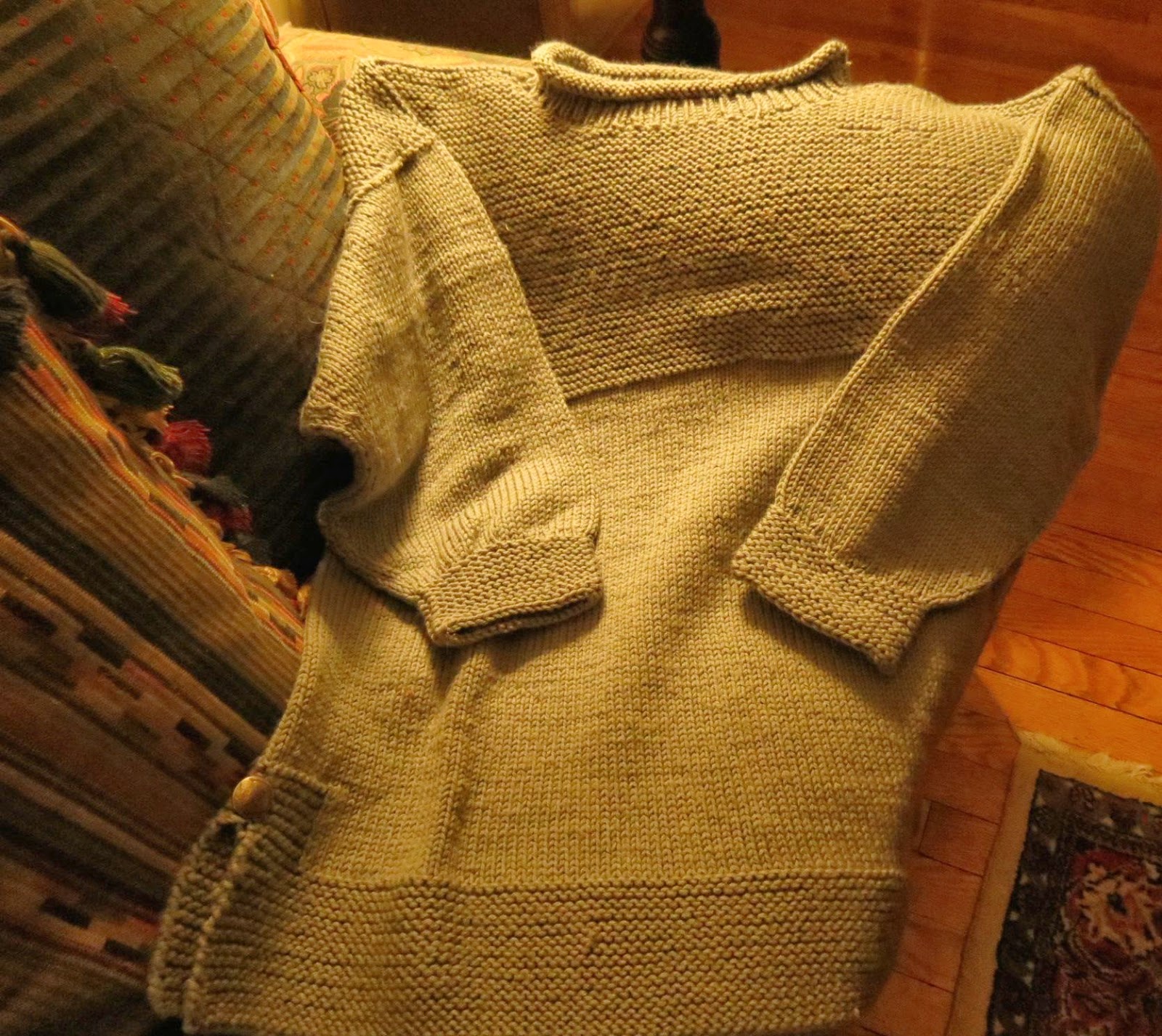
Even though I have been focused on variety of  other endeavors lately (traveling to Nicaragua, going to Baltimore, helping organize a quilt show at church), I still have been knitting.  Last month, I finished this sweater for my daughter, in lieu of her birthday socks.  She requested a sweater like the one I made for her son, so I made one, using my one of favorite go-to patterns and my favorite go-to yarns.  Once again, I realized why I don't knit many adult-sized sweaters; it takes a lot of knitting to make bigger sweaters, especially this design, an oversized comfy sweater/sweatshirt.  One thing I enjoyed in making this was fastening on these buttons, lifted from my mother's sewing box.  I wrapped it up for Barbara in a swarth of fabric designed by her high school friend Jay McCarroll


This week, I finished a pair of socks for a soon-to-be birthday boy.  Goodness..can't believe my baby boy will be 35 next week.  This yarn was sure  fun!


And if I really want to be complete with the accounting my current creative output, I probably should mention that right before Nicaragua I pieced together a little scrappy quilt for my husband to look at while I was gone.  It was really fun to just sew a bunch of leftover strings together to make this little lap quilt for our television room--so many project and people memories in the strips of fabrics.  I really like the back on this one, pieced from yellow ticking, a muslin remnant and some cool stripey material. 


This week I ordered some yarn on sale, with visions of Christmas in my head. Our sewing group tied up some of our Lutheran World Relief quilts in preparation for a big quilt display and concert next week at our church (I am sure that will be the topic of my post next week).  


Spring is here...finally. Green is rising from the brown winter ground, birds are singing more joyously, outdoor occupations resume, and it seems a collected sign of relief and exhalation of joy resounds.  Thursday night, Jim fired up the grilled and chicken, and then after supper, we pulled out our bicycles, pedaling through campus for an evening ride.  We saw the most beautiful sunset. Oh yes....Spring and all her pleasures!

Saturday, April 5, 2014

World Without End


Our daughter is a painter. Have I mentioned that before?  And have I mentioned how proud (and blessed) we are to have this gentle, accomplished, and grace-filled woman in our lives?  As an artist who creates images exploring context within the seeming chaos swirling amid the technological and media-driven life of the 21st century, Barbara seeks to find and explore "idiosyncratic order amidst disorder."  Exactly how do we make meaning out of chaos?


 Last night her solo show opened at The Schulman Project  a neat little gallery in north Baltimore, situated in the middle of a charming (in "Charm City") street, lined with shops, restaurants, and galleries.  It was this neighborhood's "First Friday," and it was a  soft April evening, perfect for strolling down the avenue.  A steady stream of people--invitees, friends, and casual passers-by, walked in and circled throughout the gallery, making for a warm night of art and conversation.


Our family converged on the city....family reunions, rarer than we'd like, are sweet, indeed.


The name of Barbara's show is "World Without End."  


 An allusion to a doxology, a liturgical hymn of praise, "world without end" is the title of this show comprising Barbara's paintings.  Word nerd that I am, I was curious about the etymology of the word "doxology":

  mid 17th cent.: via medieval Latin from Greek doxologia, from doxa ‘appearance, glory’ (from dokein ‘seem’) + -logia (see -logy).

When teaching young writers, I frequently purported that the title chosen to name a writing is worth pondering, just as their parents thought long and hard about bestowing on them the names they carry. The juxtaposition of my daughter's contemporary and abstract paintings and images, her colorful and joyful considerations of life in the 21st century, to a doxology, a phrase with deep ecclesiastical and liturgical roots, is pleasing and oh-so-very right; her work and her life are, especially to her father and to me, a certain and sweet hymn of praise.

... As it was in the beginning, is now and ever shall be, world without end. Amen.

Saturday, March 29, 2014

Spring Haiku


Searching for flowers


Hidden under Winter's brown


Spring explodes purple.


Monday, March 17, 2014

Nicaragua


Seated comfortably in the cushy, corner chair, I allow my thoughts to drift back over these past eight days in Nicaragua, a most beautiful land of an open and gracious people.  What struck me every day during our bus rides through the mountains of Jinotega was the utter glory of this uniquely, unspoiled land.  Mountains, valleys, lakes, fields, woods, small villages, sporadic clusters of hut-homes, winding roads, and free-roaming dogs, chickens, and livestock merely shift places on the unfolding canvas of this exquisite county. I tried to take photographs, and I do have some, but most often I turned off the camera, allowing the lens of my eyes to absorb all that passed before me.


While the countryside created the setting of the story, the work of our trip, taking medical care to the rural communities without easy access to health care, supplied the characters, the dialogue, the conflicts, and the themes.


The people of Nicaragua, striking with warm skins, dark eyes and thick, lustrous hair, are a proud people.  They lined up each clinic day dressed in their Sunday finest, patiently waiting for a turn to speak with a doctor about their headaches, joint paints, gastritis, fungus, difficulties breathing, sleeping, eating, etc. etc.  They rattled off multiple names--three and four primary names and two or three last names.  Castro.  Hernandez, Viagra, Rodríguez, Lopez, Gutierrez were names I wrote over and over again the day I helped register men, women, children and infants for our clinic.  Life is hard for the people of this coffee-growing region. 


(For the first time, I was able to give a prayer shawl I knit to someone who needed it. This beautiful woman lost her sister, just last week.  Together as two women, we hugged, prayed, concurrently in Spanish and English, and cried.)  

Basically, the people live outdoors, with cooking pits, beautiful arbors and small courtyards arranged for practical use and seating.  Clothes hang in neat lines strung near to the homes (very small by our overgrown standards), cobbled together from an assortment of metal, concrete, sundry pieces of wood, doors, windows, and almost always with a satellite dish affixed to the roof.


(These flats are for drying coffee beans.)


 There is more foot traffic on the rural roads than motorized traffic, which was almost entirely busses and the occasional motorcycle.  Men ride horses over the fields for work or for travel and in the village, they ride bicycles, often carrying one or more passengers, balanced on handle bars, seat bar, or back fender.  Women walk, frequently carrying infants or small children. 


And then there were the children...the children, the ones who most captured and captivated my heart.  My responsibility at the clinic was to operate the “arts and crafts” table, a place where patients could park their children while they waited to be seen and were seen by the medical professionals.  All ages sat or stood, huddled around the table.  The woman who gathered the supplies packed lots of coloring books, some scratch-off forms that yielded bright colors under a stylus, and stickers.  I brought rainbow looms, bands, and a compartmentalized container to organize an inviting array of colors.


 It became very clear, very quickly that the children were quite accomplished at coloring.  When I mentioned this to the director of the orphanage, she told me that the children spend a lot of time coloring at school and it is source of pride for them and for their families.  “Would they make pictures with blank paper and crayons,” I asked her.  “It's not likely,” she replied, explaining that following rules it is also how they learn, by rote memorization.  As an educator that shallow pedagogy deeply saddens me.  It is no wonder that only 6% of the country’s high school graduating class passed the college entrance exam (which by the way was a national scandal this year), with most of those students attending private schools. 


The school day is broken into shifts, with the younger students going in the morning, beginning early and ending by noon and the upper levels attending in the afternoon, and finishing around 5:00.  School days are frequently cut short or canceled at the discretion of the teachers.   It is easy to learn to color well between the lines, but it takes higher forms of concentrated brainwork to put ideas together, to abstract concepts, to imagine, and to create.


It pleased me to teach the children, both young and older, to “rainbow loom.”  I soon managed to paste together some simple Spanish words and phrases and with demonstrations, hand-over-hand if needed, guided instruction, gestures, nods, smiles, and lots of "Si", "muy bien", and "que bonita", I managed to teach a simple craft.  It was their job to add the art—to pick the colors, make the patterns, determine the design, the length, and the recipient.  When all the looms were in use, we worked on fingers or used the styluses we had on had.  No looming wannabe was turned away or left empty-armed.  Soon our team's youth joined in and there was laughter, noise, and friendship freely flying around the table.  


A small project, a simple activity, but perhaps it ignited a tiny spark of realization that their hands and minds could create something of use and beauty.  I am already planning and thinking of ideas for next year….and there will be, for me, a next year in Nicaragua. Esta bien. Muy bien.

Tuesday, March 4, 2014

Marching Orders


In less than a week, I leave March here in Pennsylvania (current temperature 7 degrees) to fly south to Jinotega, Nicaragua (current temperature 62 degrees).  My packing this week assumes form  The piles of things accumulating in the closet now fill a carry-on bag or a small daypack to hook around my waist.  Two pairs of pants, one pair of capris, two long-sleeved t-shirts, five short-sleeved t-shirts, a pair of flip-flops, sandals, Keens, pajamas, light jacket, bathing suit, a hat, underwear, toiletries, a book (and book light), ear plugs, journal, bible, pens, and a few more incidentals. I have been told to pack lightly; I hope I am.

Our team already packed, spending a Saturday morning seeking the most efficient and effective way to squeeze medicines, medical supplies, prayer shawls, and donations for the orphanage into a fleet of large suitcases not exceeding 50 lbs.


We are ready, and I think I am as well.  My dear sister-in-law (a seasoned world traveler) sent me bandanas, soap that serves as shampoo and conditioner, a sleeping mask, money belt, along with her welcomed counsel. My sweet friends held a luncheon to send me off, showering me with love and donations for the orphanage (can you tell we are all retired teachers?!).  It all is such an encouragement, as I freely admit a sense of nervousness at flying off to places and experiences very unknown to me.


But this whole thing is really not about me.  It is simply a response to two questions--Can you go?  Will you help?  Thus I go, part of a team commissioned to bring medical help to a country where such help is in severely limited supply.  I go to help by summoning whatever talents I possess to be of use: to my team, to the people in the mountains of Nicaragua, and to the children and staff of the orphanage where we shall stay.  I go to listen, to watch, to learn, to work, and above all to love.

p.s. As part of my team, I will be the official "blogger."  You can follow our trip by accessing our team blog found here.